Car Market Performance

Oct 02, 2026

Mahindra SUV Sales Reach 64,092 in September 2026: What It Signals

Mahindra & Mahindra reported domestic utility-vehicle sales of 64,092 units in September 2026, up 14% from 56,233 units in September 2025. The result extends a strong first half of the financial year: cumulative utility-vehicle volume reached 3,58,142 units through September, compared with 2,97,570 a year earlier, a 20% increase.

These are company-reported wholesale numbers from Mahindra's official sales release dated 1 October 2026. They show vehicles billed into the sales channel rather than retail registrations made to individual customers. That distinction is essential when interpreting market momentum, dealer stock and delivery conditions.

Mahindra September 2026 sales at a glance

Measure September 2026 September 2025 Year-on-year change
Domestic utility vehicles 64,092 56,233 14%
Domestic LCVs below 2 tonnes 4,044 3,386 19%
Domestic LCVs from 2 to 3.5 tonnes 26,376 23,342 13%
Domestic three-wheelers, including electric 16,343 13,017 26%
Exports 4,019 4,320 -7%

Mahindra said total automotive sales, including exports, reached 1,14,874 vehicles in September, 15% higher year on year. The company notes that this total combines SUVs, light commercial vehicles below 3.5 tonnes, three-wheelers and exports. It should not be read as a passenger-SUV number.

Why the 64,092 SUV figure matters

September's domestic utility-vehicle total was 7,859 units above the year-earlier month. More significant than one month's increase is the cumulative trend. Mahindra's utility-vehicle wholesales rose by 60,572 units during the April-to-September period, producing the reported 20% year-on-year growth.

Sustained growth across six months generally gives a clearer view of operating momentum than an isolated festive-period spike. It suggests that Mahindra has supported higher channel supply over an extended period. The release does not disclose model-wise volume, plant utilisation, order backlog or retail registrations, so it cannot establish which nameplate contributed most or whether every variant has become easier to obtain.

Wholesale growth does not automatically mean shorter waiting periods

Wholesale sales record vehicles supplied or billed to the channel. Customer deliveries depend on the model, powertrain, variant, colour, dealership allocation and location. A company can report higher wholesales while an in-demand configuration still has a waiting period, or while another configuration is readily available.

Buyers should ask for the vehicle identification number, manufacturing month and written delivery commitment before completing payment. They should also compare dealer inventory across nearby cities instead of assuming that the national sales figure reflects local availability. Any promised delivery date or price protection should appear on the booking document.

Electric Origin SUVs cross a one-lakh billing milestone

Mahindra also said it has crossed one lakh billings of its “Electric Origin” SUVs since launch. The company included this milestone in the management comment accompanying the September sales data, but the release does not provide a model-wise split, a month-by-month electric-SUV table or a separate retail-delivery count.

“Billing” should therefore be interpreted as the company's stated channel measure rather than one lakh confirmed end-customer registrations. Even so, the milestone shows that Mahindra's new electric-SUV line has reached meaningful commercial scale in the manufacturer's own reporting.

For an EV buyer, market scale can support greater dealer familiarity, service training and parts planning, but it does not replace vehicle-specific checks. Confirm the certified range, battery warranty, charging rate, home-charger scope, installation requirements, insurance treatment and service support for the exact variant. Real-world range will vary with driving conditions and use.

Commercial vehicles and three-wheelers broaden the growth story

Mahindra's domestic commercial-vehicle sales were 30,420 units in September, 14% higher year on year. Within the published table, light commercial vehicles below 2 tonnes rose 19% to 4,044 units, while the 2-to-3.5-tonne category increased 13% to 26,376 units.

Domestic three-wheeler volume, including electric three-wheelers, reached 16,343 units, a 26% increase. Cumulative three-wheeler sales for the financial year through September were 82,058 units versus 53,578 a year earlier, a 53% rise. That makes three-wheelers the fastest-growing domestic category shown in the release, although the company does not separate electric and internal-combustion volume in this table.

The broader category mix matters because the 1,14,874 total is not driven solely by SUVs. Mahindra's automotive business serves personal mobility, goods transport and last-mile operations, so performance should be evaluated by segment rather than by applying one headline growth rate to every product line.

Exports fell in September but remain ahead year to date

Exports were the one category in the release to decline for the month. Mahindra shipped 4,019 vehicles in September 2026, down 7% from 4,320 in September 2025. However, cumulative exports through September rose 48% to 30,031 units from 20,303 units in the corresponding period.

The contrast is a reminder that monthly data can be volatile because of shipment schedules, market allocation and logistics. One weaker month does not reverse the year-to-date gain, just as one strong month would not prove a permanent change. The next quarterly and monthly releases will show whether the cumulative export growth remains durable.

What the sales mix signals about Mahindra's strategy

The figures point to three active growth engines. Domestic SUVs remain the largest reported segment, electric-origin products have crossed a company-reported billing milestone, and last-mile three-wheelers are expanding rapidly. Meanwhile, light commercial vehicles continue to grow at double-digit rates, and cumulative exports remain well above the prior-year period despite September's decline.

This spread can reduce dependence on one vehicle category, but the release alone does not reveal profitability, discounts, inventory days or capacity constraints. Strong unit growth is useful evidence of scale; financial results and retail-registration data are needed for a fuller assessment of business quality and end-customer demand.

What SUV buyers should watch next

  • Model-wise retail registrations and dealership stock, rather than only company wholesales.
  • Waiting periods for the exact powertrain, variant and colour under consideration.
  • Whether higher supply results in steadier delivery commitments or better dealer choice.
  • Official updates on electric-SUV billings, retail deliveries and charging support.
  • Variant-level safety, warranty and connected-feature terms in the current brochure.
  • The complete on-road quotation, including insurance, registration, accessories and any dealer charges.

Mahindra September 2026 sales: the takeaway

Mahindra's September result combines a high domestic SUV run rate with broad growth across commercial and last-mile categories. The 64,092 utility-vehicle total was 14% above last year, and the 20% year-to-date increase indicates that the momentum extends beyond a single month. The one-lakh Electric Origin SUV billing milestone adds an important electrification signal.

For buyers, the headline should be used as context rather than a shortcut. Check actual local stock, the written delivery date, current variant specification and full on-road cost. If you are comparing Mahindra SUVs or alternatives, use AutoCred to check an indicative eligible loan amount and estimated EMI before paying a booking amount. Results are indicative; final eligibility, interest rate, tenure, documentation and approval remain subject to the lender's verification and policy.

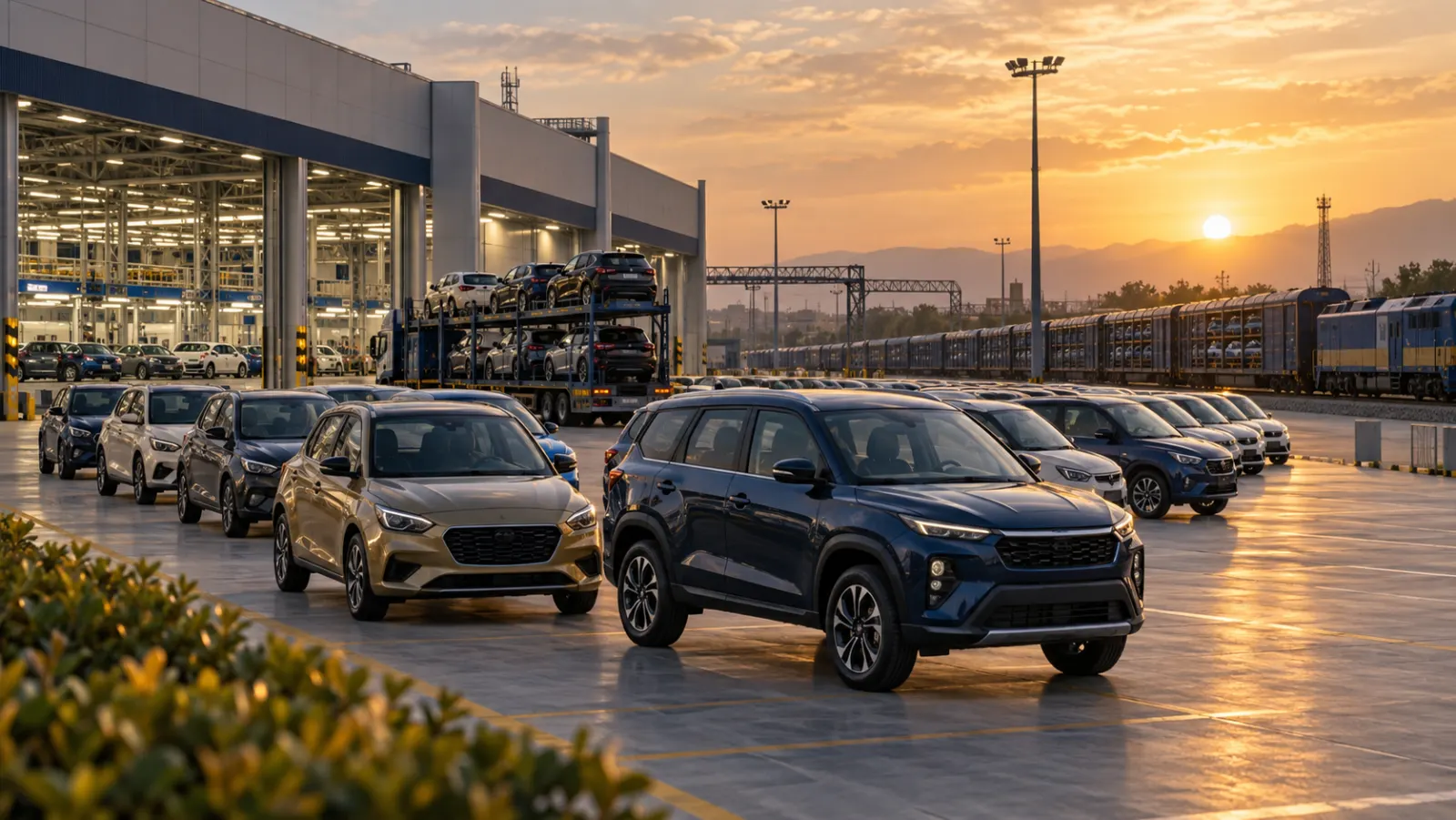
Primary source: Mahindra & Mahindra — September 2026 automotive sales release, published 1 October 2026. Accessed 2 October 2026. The cover image is an illustrative depiction of generic unbranded SUVs and does not show an official Mahindra vehicle design.

Read more
Oct 01, 2026

Toyota India's 3.42-Lakh Capacity: What Its 2026 Report Signals

Toyota Kirloskar Motor’s latest sustainability report provides a useful snapshot of the scale and direction of its Indian operations. The company lists installed production capacity of up to 3,42,000 vehicles a year across two plants at Bidadi, Karnataka, while describing a strategy that spans hybrids, battery-electric vehicles, hydrogen technologies and alternative fuels.

The figures come from Toyota’s official Sustainability Report 2026 announcement dated 29 September 2026. Installed capacity shows how much the manufacturing system is designed to produce under stated conditions; it is not the same as current output, wholesales, retail registrations or confirmed future demand. That distinction matters when assessing what the report signals for Toyota’s market performance in India.

Toyota India production capacity: how the 3.42-lakh figure is divided

Toyota reports capacity of up to 1,32,000 units at its first Bidadi plant and up to 2,10,000 units at the second plant. Together, those numbers produce the stated total of up to 3,42,000 vehicles annually. The manufacturer’s plant overview says the first facility began production in December 1999, while the second began production in December 2010.

The first plant manufactures the Innova HyCross, Innova Crysta, Fortuner and Legender. The second plant manufactures the Camry Hybrid, Urban Cruiser Hyryder and Hilux. Toyota separately lists the Glanza, Rumion, Urban Cruiser Taisor and Urban Cruiser Ebella among its other Indian models, while the Vellfire and LC 300 are identified as completely built-up imports.

This allocation gives Toyota locally manufactured products across MPVs, SUVs, a pickup and a premium hybrid sedan. From a business perspective, that mix allows the company to serve several price and usage segments from the same manufacturing base. Buyers should still check the production origin, waiting period and current availability of the exact model and variant they are considering, because plant capacity alone does not reveal dealer stock or delivery timing.

What the capacity figure does and does not tell buyers

A capacity number is best read as operating headroom. It can support higher production when demand, components and model allocation are available, but it does not prove that every line is running at full utilisation. Toyota’s 29 September release does not publish plant utilisation, model-wise output, domestic-versus-export allocation or September sales in this announcement.

For customers, the practical evidence will come from dealership supply, variant availability, quoted waiting periods and future wholesale or registration data. A well-sized manufacturing base can help a company respond to demand, but delivery performance also depends on engines, batteries, semiconductors, logistics, supplier readiness and the mix of vehicles dealers require.

A multi-pathway strategy rather than one powertrain

Toyota says its India strategy follows a multi-pathway approach covering hybrid electric vehicles, battery-electric vehicles, hydrogen-powered technologies and alternative fuels. The company presents these technologies as different routes for reducing emissions across varied customer needs and operating conditions.

The same official release states that Toyota vehicles account for nearly 80% of hybrids sold in India. It also identifies the Urban Cruiser Ebella as Toyota’s first battery-electric vehicle in the country. Those are material strategic signals: Toyota continues to rely heavily on hybrids while adding a dedicated battery-electric option to its Indian portfolio.

Buyers should treat powertrain labels as the beginning of a comparison, not the conclusion. A strong hybrid, battery EV, petrol vehicle or another alternative can suit different patterns of daily distance, charging access, highway use and ownership duration. Compare the complete on-road cost, warranty terms, expected energy or fuel use, service access, usable space and real test-drive experience for the exact variant.

Why Toyota’s hybrid position matters

The nearly 80% hybrid-share claim indicates that Toyota currently holds a substantial position within India’s hybrid market. It does not mean hybrids represent 80% of all Indian passenger-vehicle sales, and the release does not provide the underlying unit total or period used for the calculation. Readers should therefore avoid converting the percentage into an unsupported sales estimate.

Strategically, hybrid demand can support models such as the Innova HyCross, Urban Cruiser Hyryder and Camry Hybrid listed in Toyota’s production overview. The buyer implication is more practical: ask for the precise powertrain, certified efficiency figure, battery warranty and variant equipment in writing. A model name may include petrol and hybrid versions with different prices and ownership economics.

The Urban Cruiser Ebella adds a battery-electric route

Toyota describes the Urban Cruiser Ebella as its first BEV in India, but the sustainability announcement is not a complete buying guide. It does not contain a full price list, variant specifications, charging curve, real-world range, delivery schedule or city-wise allocation. Those details should come from the model’s official product material and dealership quotation rather than assumptions based on the sustainability report.

For an EV shopper, the most useful checks include home-charging feasibility, connector and public-network compatibility, battery and vehicle warranty, highway charging on regular routes, insurance, tyre replacement costs and how range changes with speed, climate control and passenger load. Finance planning should include the full on-road amount and any charger or installation costs shown in the written quotation.

Manufacturing sustainability indicators in the report

Toyota says its manufacturing facilities have operated on 100% renewable electricity for five consecutive years, eliminating Scope 2 emissions from manufacturing operations. Since FY2012-13, the company reports avoiding more than 5,94,000 tonnes of carbon-dioxide emissions, recycling more than 95% of manufacturing waste and meeting over 90% of its water needs through recycling and rainwater harvesting. Each of these figures is reported in the Toyota Sustainability Report 2026 announcement.

These measures relate to operational sustainability and should not be confused with a vehicle’s certified fuel economy, tailpipe emissions or lifecycle footprint. They do, however, show concrete actions within manufacturing: renewable power, waste recovery and water reuse. Future reports can be used to track whether Toyota maintains or improves these indicators as production and its product mix evolve.

People, training and the scale of the Indian operation

The report lists 6,662 employees at Toyota Kirloskar Motor. It also says Toyota’s training institute and partnerships with more than 120 Industrial Training Institutes and over 30 Government Tool Room and Training Centres have trained more than 1,40,000 young people. Toyota reports community-development spending of more than ₹1,047 million in FY2025-26 and says its initiatives have reached more than 7.4 million people since inception.

Workforce and skill development matter to manufacturing performance because product quality, maintenance, supplier capability and process improvement depend on trained people. The release does not translate these programmes into a model-specific quality or service guarantee, so buyers should continue to assess local dealership and service-centre performance directly.

What to watch in Toyota India’s next performance updates

  • Actual monthly and quarterly wholesales compared with the stated 3,42,000-unit installed capacity.
  • Model-wise supply and waiting periods across the two Bidadi plants.
  • The sales contribution of hybrids and the Urban Cruiser Ebella after wider availability.
  • Any official capacity expansion, supplier localisation or new-model allocation.
  • Progress on renewable electricity, water reuse, waste recovery and reported emissions.
  • Dealer and service coverage as the powertrain portfolio becomes more varied.

What the 2026 report signals

Toyota’s Indian operation combines meaningful manufacturing scale with a deliberately broad powertrain strategy. Capacity of up to 3,42,000 units gives the company a sizeable local base, while its hybrid position and first Indian BEV show that future growth is not tied to a single technology.

The next test is execution. Buyers and market observers should track whether capacity translates into dependable supply, whether electrified models reach enough customers at competitive on-road prices and whether the company’s sustainability indicators continue improving. The report provides direction and operating context; current sales releases, product brochures and written dealer quotations remain essential for a purchase decision.

Check indicative eligibility before selecting a variant

When comparing a Toyota or any other new car, check your indicative eligible loan amount and estimated EMI with AutoCred before shortlisting a variant or paying a booking amount. This can help align the on-road price, down payment and monthly commitment before you visit the showroom. Results are indicative; final eligibility, interest rate, tenure, documentation and approval remain subject to the lender’s verification and policy.

Primary source: Toyota Kirloskar Motor — Sustainability Report 2026 announcement, 29 September 2026. Accessed 1 October 2026.

Read more
Sep 30, 2026

Stellantis India Targets 160% Output Growth at Thiruvallur Plant

Stellantis has taken full ownership of its vehicle manufacturing operation in Thiruvallur, Tamil Nadu, and has set a clear production target for the plant. The company plans to increase annual output from 16,000 vehicles in 2026 to more than 43,000 by 2028, an expansion it describes as exceeding 160%.

The change follows Stellantis India’s acquisition of the remaining stake in Stellantis Automobiles India Private Limited from Hindustan Motor Finance Corporation, a CK Birla Group company. According to the official announcement dated 21 September 2026, the transaction was funded through foreign direct investment and gives Stellantis full control of the Thiruvallur company and manufacturing operations.

What full ownership changes for Stellantis India

Stellantis says a fully owned structure will allow deeper operational integration, faster decision-making and greater flexibility. The company and CK Birla Group first entered the manufacturing partnership in 2017, while vehicle assembly at Thiruvallur began in 2021. The latest transaction simplifies that structure as Stellantis prepares to scale production and exports.

For the business, this can shorten the path between product planning, investment decisions, supplier coordination and factory execution. It does not automatically guarantee new launches, lower vehicle prices or shorter waiting periods. Those customer outcomes will depend on how quickly the planned investment and production ramp translate into model allocation, components, dealer supply and demand.

Production is planned to rise from 16,000 to over 43,000 units

The most concrete measure of the plan is annual output. Stellantis is targeting more than 43,000 vehicles in 2028, compared with 16,000 in 2026. The company release characterises this as an increase of more than 160% over two years.

That target implies a substantial increase in utilisation and manufacturing activity, but it is a forward-looking plan rather than a completed sales result. Production can support domestic dispatches, exports or both, and the mix may change with market demand. Future performance should therefore be assessed through actual plant output, wholesale data, exports and retail availability rather than the target alone.

Which cars are built at the Thiruvallur plant?

The Thiruvallur facility currently manufactures the Citroën C3, ë-C3, C3 Aircross and Basalt. Stellantis reports localisation of more than 95% at the plant. These model and localisation details are included in the full-ownership announcement.

High localisation can support supply continuity, parts availability and cost control because more of the vehicle’s value chain sits close to production. Buyers should still compare the actual on-road price, warranty, service reach and spare-parts quotations for a specific model. A localisation percentage by itself does not confirm the final ownership cost or resale value.

India’s role extends beyond domestic production

Stellantis says Thiruvallur currently serves eight export markets across four continents. An earlier official plant update from 23 April 2026 linked vehicles produced on the Smart Car platform with markets in Latin America, the Middle East and Africa, and marked the rollout of the plant’s 50,000th vehicle.

Exports matter because they can spread the fixed cost of tooling, engineering and supplier development over more vehicles. A factory serving several regions can also become more important within a global production network. At the same time, export demand can compete with domestic allocation, so the buyer-facing measure will be whether Indian dealers receive enough of the variants customers actually want.

Investment and workforce expansion

Stellantis states that it has invested more than €1 billion in India across manufacturing, product development, localisation and capability building. In the same announcement, the company’s India leadership described investment as close to ₹11,000 crore. These figures cover the wider India ecosystem and should not be read as an amount committed solely to the Thiruvallur plant.

The direct workforce at Thiruvallur is projected to more than double from 610 employees in 2026 as output expands, according to the September release. Stellantis also expects additional indirect employment across suppliers and logistics. Delivery against this projection can be monitored through future company disclosures and local hiring rather than assumed in advance.

How the plan could improve market performance

Stellantis identifies four priorities for the next phase: new-product investment, greater manufacturing capacity, stronger export competitiveness and deeper localisation. Together, these actions address several challenges faced by a smaller automotive player in India. A broader product pipeline can attract more customer segments, while higher production and exports can improve scale.

Deeper localisation may also make it easier to respond to market changes and source components closer to the factory. Faster decision-making under full ownership could help the company align model configurations and production schedules with demand. The result will still depend on product relevance, pricing, dealer reach, after-sales support and the pace at which announced plans reach showrooms.

What this could mean for Citroën customers

For customers, the most useful potential benefits are steadier availability, a wider choice of locally produced variants and improved parts supply. None of these is promised as an immediate consequence of the ownership change, so buyers should check current waiting periods and service support directly with authorised dealers.

The plant already builds petrol and electric models across different body styles. If production grows as planned, Stellantis will have more room to balance domestic demand and export commitments. Buyers should watch for official model announcements, capacity milestones and dealer-stock trends rather than relying on unofficial product rumours.

What the announcement does not confirm

The official release does not announce a new model, an India launch date, additional factory capacity in units beyond the 2028 output target, or any price reduction. It also does not provide a domestic-versus-export split for the planned 43,000-plus vehicles. Those details may become clearer as Stellantis publishes future product and operating updates.

It is also important to distinguish production from retail sales. A vehicle can be assembled for export, dealer inventory or later delivery. The strongest evidence of improved Indian market performance will therefore combine production data with registrations, dealer expansion, after-sales indicators and customer demand.

Key indicators to watch through 2028

  • Annual output at Thiruvallur compared with the stated 16,000-to-43,000-plus target.
  • The share of production allocated to India and the eight existing export markets.
  • New locally produced models or variants officially assigned to the plant.
  • Changes in dealer stock, waiting periods, parts availability and service coverage.
  • Workforce growth from the 610 direct employees reported for 2026.
  • Further localisation and supplier investments around Tamil Nadu.

Why the Thiruvallur plan matters

The ownership transaction gives Stellantis a simpler operating structure at a time when it wants India to play a larger role in manufacturing, engineering and exports. A planned increase of more than 160% in annual output is a material target for the facility, and the existing export footprint gives the plant more than one route to scale.

Execution will determine the impact. Buyers and market observers should look for evidence in production, product availability and service support over the next two years. If the company turns capacity and localisation into competitive vehicles with dependable ownership support, Thiruvallur can become a stronger base for both domestic growth and exports.

Check indicative eligibility before selecting a car

When comparing a Citroën or any other new car, check your indicative eligible loan amount and estimated EMI with AutoCred before choosing a variant or paying a booking amount. This can help keep the on-road price, down payment and monthly commitments aligned. Results are indicative; final eligibility, interest rate, tenure, documentation and approval remain subject to the lender’s verification and policy.

Primary sources: Stellantis India — full ownership of Thiruvallur manufacturing operation, 21 September 2026; Stellantis India — 50,000th Smart Car platform vehicle, 23 April 2026. Accessed 30 September 2026.

Read more
Sep 29, 2026

Kia India’s Growth Plan: 302,000 Sales Target and Dealer Expansion

Kia has set a 2026 India retail-sales target of 302,000 vehicles, an 8% increase over the 280,000 units reported for 2025. The company’s official 2026 CEO Investor Day presentation links that growth plan to the new Seltos, India-focused battery-electric vehicles, a richer product mix and a larger dealer network.

This is a forward-looking target rather than a completed sales result. Kia’s official investor presentation says India sales grew 14.9% in 2025 to 280,000 units and market share reached 6.1%, up 0.4 percentage points. The 302,000-unit goal shows that Kia expects growth to continue, but actual performance will depend on demand, launches, supply and competitive conditions.

What Kia’s 2025 India performance shows

Kia’s investor material attributes its 2025 improvement to upgraded technology features and product actions including the Syros and an updated Carens. It reports 132,000 A-SUV sales, up 31.6% year on year. The presentation also says the updated Carens achieved 21% year-on-year volume growth and a 21% share of the B-MPV segment.

These figures matter because they show that Kia’s growth was not presented as a simple market-wide uplift. The company points to specific products and higher-value features as important drivers. For buyers, that strategy can create more choice and equipment, although it can also make variant comparison more complicated when safety, powertrain and convenience features differ across trims.

The 302,000-unit target depends on product mix

For 2026, Kia’s plan targets 302,000 India sales and an improvement in average selling price and mix through the new Seltos and India-specific electric-vehicle launches. The presentation sets a goal of 25% year-on-year volume growth for the Seltos, supported by a greater contribution from higher trims.

Higher-trim growth can improve revenue even when overall volumes rise more gradually, but it also means customers should compare equipment carefully. A premium variant may add driver-assistance, connectivity or comfort features, while the lower trim may deliver the stronger value proposition. The correct choice depends on the feature set a buyer will actually use and the total on-road price.

Dealer expansion is a central part of the plan

Kia says it intends to establish sales capacity of 400,000 units over the mid to long term by adding 50 dealers, taking the total to 590. Sales capacity is not the same as guaranteed sales or factory output; it describes the commercial network Kia wants in place to support a larger customer base.

A wider network can have practical value beyond new-car sales. More dealer coverage may improve access to test drives, delivery coordination, authorised service and warranty support, particularly outside the largest metropolitan areas. The benefit will depend on where the new outlets open and whether service capacity grows alongside the sales network.

India’s role in Kia’s wider emerging-market strategy

Kia’s official CEO Investor Day announcement of 9 April 2026 identifies emerging markets as a major part of its global growth plan. The company targets 1.48 million annual sales across emerging markets by 2030, compared with one million units in 2025. Kia’s India strategy combines local product actions with dealer expansion as part of that broader push.

The company’s India operations already have a substantial local base. Kia India says mass production at its Anantapur facility began in August 2019 and lists approximate annual production capacity of 300,000 units on its official India profile. Future sales growth will therefore require coordinated decisions across production, sourcing, inventory, logistics and retail reach.

What the strategy could mean for car buyers

The most direct buyer impact is likely to come through product choice and retail access. New and updated models can increase competition in SUVs, MPVs and electric vehicles, while a larger network may make the brand easier to evaluate and maintain in more locations. Neither outcome guarantees a lower purchase price, shorter waiting period or better resale value.

Growth targets can also encourage companies to use finance schemes, exchange programs and special editions to attract customers. Buyers should separate temporary promotions from the underlying transaction. An itemised quotation should show the ex-showroom price, registration, insurance, accessories, warranty packages and any finance-linked conditions before a booking amount is paid.

A practical checklist when comparing Kia variants

  • Compare the exact standard safety equipment on each trim, rather than assuming a headline feature applies across the range.
  • Request an itemised on-road quotation and verify whether discounts require dealer insurance, accessories or a particular loan.
  • Check service-centre distance, appointment availability and warranty terms in your city.
  • Test rear-seat comfort, luggage space, visibility and ride quality with your normal family use in mind.
  • Compare the down payment, EMI and total repayment across sensible loan tenures.

How to read Kia’s targets responsibly

The 302,000-unit sales goal, Seltos growth target and planned dealer expansion show management’s direction; they are not promises to customers or confirmed year-end outcomes. Sales targets may change with market demand, product timing, supply constraints and the pace of network execution.

For shoppers, company-performance data is most useful as context. It can reveal where a manufacturer is investing and which segments it considers important. The final buying decision should still rest on the exact vehicle, verified specifications, test-drive experience, on-road cost and quality of local after-sales support.

Check indicative eligibility before you book

If a Kia model or another new car is on your shortlist, check your indicative eligible loan amount and estimated EMI with AutoCred before visiting a dealer or paying a booking amount. It can help you set a practical vehicle budget and compare variants with a clearer monthly-cost estimate. Final eligibility, interest rate, tenure, documentation and approval remain subject to the lender’s verification and policy.

Primary sources: Kia 2026 CEO Investor Day announcement; Kia 2026 CEO Investor Day presentation; and Kia India company profile. Accessed 29 September 2026.

Read more
Sep 28, 2026

Maruti Suzuki’s Green Manufacturing Push: Hydrogen, Rail and Exports

Maruti Suzuki is expanding its manufacturing strategy beyond production volume. During September 2026, the company announced a green-hydrogen pilot at Manesar, a major rail-logistics milestone and more than one lakh cumulative exports of three India-made models to Japan. Read together, these developments show how India’s largest carmaker is working on energy use, dispatch efficiency and export scale at the same time.

The newest step is a 300 kW green-hydrogen electrolyser commissioned as a pilot at the Manesar plant. Maruti Suzuki says the hydrogen will be blended with natural gas and used as process fuel in manufacturing. The company’s official 24 September 2026 announcement explains that surplus solar energy generated during holidays can produce hydrogen for storage and later use.

Why the 300 kW hydrogen pilot matters

This is a manufacturing trial rather than a hydrogen-powered passenger-car announcement. The immediate purpose is to test how green hydrogen can replace part of the natural gas used in plant processes. Maruti Suzuki says it will use the Manesar pilot to learn before considering wider adoption across its facilities in Haryana and Gujarat.

The company has set an aspiration to reduce manufacturing carbon emissions from 615,000 tonnes to 266,000 tonnes in FY 2030-31. Its green-hydrogen release also lists a 1 MWh battery energy-storage system already commissioned at Kharkhoda and a 10-tonne-per-day biogas plant planned there within FY 2026-27. These projects indicate a multi-technology approach: solar, storage, hydrogen and biogas each address a different part of plant energy demand.

Rail dispatch is becoming a larger part of the logistics network

Cleaner production is only one part of the operating model. Maruti Suzuki has also reported one million cumulative vehicle dispatches through its in-plant railway sidings at Hansalpur and Manesar. The official rail-logistics update attributes about 7.9 lakh vehicles to the Gujarat siding and around 2.1 lakh to Manesar.

The Gujarat siding began operating in March 2023 and the Manesar facility in June 2025. According to the company, these two in-plant terminals handled 70% of its rail-based dispatches in FY 2026-27 up to the announcement, while total rail dispatches crossed three lakh vehicles by 31 August. Loading vehicles inside the plant reduces the need to move them by truck to an external railway terminal, which can simplify handling as well as reduce road movement.

Maruti Suzuki says the share of vehicles dispatched by rail increased from 5% in FY 2014-15 to 26.5% in FY 2025-26. Its stated mid-term goal is 35% by FY 2030-31, supported by further rail infrastructure including an in-plant siding at Kharkhoda. That target is forward-looking, but the one-million-vehicle milestone shows that rail is already material to the company’s distribution system.

Exports add another reason to strengthen manufacturing

Maruti Suzuki’s September export update says combined shipments of the India-made Jimny 5-door, FRONX and e VITARA to Japan have crossed one lakh units. FRONX exports to Japan started in August 2024, followed by the Jimny 5-door in December 2024 and the e VITARA in September 2025. The company states that the Jimny 5-door and e VITARA are manufactured exclusively in India.

Japan was Maruti Suzuki’s second-largest export market by volume in FY 2025-26 and retained that position during April-August FY 2026-27. In the same period, the company exported more than 1.8 lakh vehicles across its international markets. Maruti Suzuki’s official export milestone announcement also cites SIAM data for a share of more than 50% of India’s passenger-vehicle exports during April-July FY 2026-27.

What this strategy means for Indian car buyers

Factory-energy and logistics investments do not automatically translate into lower showroom prices. Pricing still depends on input costs, product positioning, taxes, demand and company decisions. Their practical value for buyers is more indirect: a manufacturer with flexible energy sources, efficient dispatch infrastructure and a broad export base may be better equipped to manage production scale and move vehicles across markets.

Export acceptance can also provide a useful quality signal, but it does not mean that every export specification is available in India. Buyers should compare the exact Indian variant, safety equipment, warranty, delivery estimate and on-road price. The product on a dealer quotation—not the export model described in a corporate announcement—is the relevant basis for a purchase decision.

A practical way to use company-performance news

  • Separate operational milestones from product announcements; the hydrogen plant does not introduce a new hydrogen car.
  • Use export and logistics data to understand company direction, not to predict a guaranteed delivery date.
  • Ask the dealer for an itemised on-road quotation and a written variant specification.
  • Compare the down payment, EMI and total repayment before booking.
  • Keep insurance, maintenance and registration costs outside the advertised ex-showroom price.

Check indicative eligibility before the dealer visit

If a new Maruti Suzuki model or another vehicle fits your shortlist, check your indicative eligible loan amount and estimated EMI with AutoCred before paying a booking amount. The result can help you set a practical vehicle budget and compare variants with a clearer monthly-cost estimate. Final eligibility, interest rate, tenure, documentation and approval remain subject to the lender’s verification and policy.

Primary sources: Maruti Suzuki green-hydrogen plant announcement; Maruti Suzuki rail-dispatch milestone; and Maruti Suzuki Japan export milestone. Accessed 28 September 2026.

Read more
Sep 28, 2026

Nissan India August 2026: 147% Domestic Growth and Tekton Export Strategy

Nissan Motor India’s August 2026 numbers show a business trying to build scale on two fronts at once: a broader domestic SUV portfolio and a larger export role for its Chennai manufacturing base. According to the company’s official August performance release, Nissan recorded total wholesale dispatches of 9,350 vehicles during the month, including 3,426 units for India and 5,924 units for overseas markets.

The headline 147% year-on-year increase in domestic wholesale is significant, but the mix behind the number is equally important. Nissan attributed the improvement to continued demand for the Magnite and Gravite, along with the market response to the Tekton. This gives the company three distinct SUV propositions instead of depending on a single volume model.

Nissan’s August 2026 sales mix: exports remained the larger engine

Exports accounted for about 63.4% of Nissan’s 9,350 total August wholesale units, based on an AutoCred calculation using the figures disclosed by the company. Domestic dispatches represented the remaining 36.6%. That split shows why Nissan’s India strategy cannot be judged only by showroom sales within the country.

The figures are wholesale dispatches, which means vehicles supplied into dealer or export channels. They should not be read as retail registrations or final customer deliveries. A stronger assessment of domestic momentum will require several months of retail data, dealer inventory movement and model-wise demand. Even so, the 147% domestic growth indicates that the expanded product range is giving Nissan a broader base from which to compete.

Tekton adds a second growth route through exports

Nissan said it dispatched the first export batch of more than 1,300 Tekton SUVs to South Africa, Bhutan and Nepal. The company described this as the first phase of the model’s international journey, with additional markets expected to follow progressively.

The export start matters because the Tekton was designed from the outset for both Indian and overseas customers. At its July 2026 world premiere, Nissan identified the Chennai-built C-SUV as a central part of its India resurgence and its “One Car, One World” approach. The model therefore serves two jobs: it expands Nissan’s domestic presence in a competitive SUV segment and gives the Chennai operation another export product.

“One Car, One World” builds on the Magnite export playbook

Nissan has already used the same manufacturing-and-export model with the Magnite. In its November 2024 Magnite export announcement, the company said more than 2,700 units had been sent to South Africa within a month of launch and that the Chennai-built SUV would reach more than 65 international markets.

The Tekton’s first overseas dispatch suggests Nissan is extending that playbook to a larger, more premium vehicle. Shared production for India and export markets can support better plant utilisation and a wider production base. For the brand, it also reduces reliance on demand from one geography. The practical test will be whether export volumes remain consistent while domestic supply and service support grow with the range.

What Nissan must do to convert product momentum into durable growth

A new model can create an early wholesale jump, but sustainable performance depends on repeat demand. Nissan has identified a growing product portfolio, improved customer experience and a wider international footprint as its priorities. For India, that puts execution in three areas under focus:

  • Dealer reach and availability: buyers need reasonable access to display cars, test drives, deliveries and service support outside the largest cities.
  • Balanced inventory: dispatch growth is healthier when it follows customer demand instead of accumulating as dealer stock.
  • Portfolio consistency: Magnite, Gravite and Tekton must attract different buyer groups while maintaining a clear Nissan SUV identity.

The next few months should show whether August was mainly the benefit of a product launch and initial export loading, or the beginning of a higher operating level. Domestic retail registrations, export continuity and the pace of dealer expansion will be the useful indicators to watch.

What the strategy means for Indian car buyers

A larger locally manufactured portfolio can improve choice, variant availability and long-term confidence in the brand’s India operations. Buyers should still compare the complete on-road cost, realistic delivery time, service access, safety equipment and resale expectations for the exact variant under consideration. Wholesale growth alone does not determine whether a particular vehicle is the right purchase.

If you are planning a Nissan or another new car purchase, use AutoCred India’s car loan eligibility checker to estimate a suitable financing range before visiting the dealership. The result is indicative; final eligibility, rate, tenure and approval depend on the lender’s assessment and policy.

Sources: Nissan Motor India — August 2026 wholesale and Tekton export update; Nissan Motor India — Tekton world premiere; Nissan Motor India — Magnite export announcement. Accessed 28 September 2026.

Read more
Sep 26, 2026

Honda Cars India Growth Strategy: Sales, Hybrids and Parts Expansion

Honda Cars India entered the 2026 festive period with a clearer growth story than one monthly sales headline can show. The company reported 7,508 total vehicle sales in August 2026, including 5,385 domestic units and 2,123 exports. Domestic volume was 40% higher than the 3,850 units recorded in August 2025.

Honda attributed the domestic improvement to festive demand beginning with Onam and the market response to the New City and ZR-V. The product activity matters, but Honda is also investing behind the ownership experience. A new hybrid flagship, a refreshed sedan and a major spare-parts warehouse expansion show how the company is trying to build growth across both sales and after-sales operations.

August sales grew strongly year on year, with a sequential reality check

August's 5,385 domestic units represent a substantial year-on-year gain. The comparison should still be read alongside July, when Honda recorded 6,014 domestic sales and 8,284 total sales. August was therefore lower than July in absolute domestic and total volume even though it remained much stronger than the same month a year earlier.

That distinction is useful for buyers and industry watchers. A year-on-year percentage can show recovery from a softer base, while a month-on-month comparison can be influenced by dispatch timing, inventory and the festival calendar. The encouraging signal is that Honda delivered year-on-year domestic growth in both July and August rather than relying on a single isolated month.

New City and ZR-V are widening Honda's product reach

Honda said the New City and ZR-V contributed to its recent momentum. When the two models were introduced in May, the company described India as one of its top three focus markets and outlined six strategic launches for 2026. This signals a broader portfolio plan rather than a one-model sales push.

The ZR-V has a different job from Honda's locally manufactured Amaze, City and Elevate. It arrived as a premium hybrid SUV imported from Japan as a completely built unit. Honda announced an introductory ex-showroom Delhi price of ₹47.99 lakh and said the first two India batches had already been booked when deliveries began in July. At that price and import volume, it is unlikely to be Honda's mass-market volume engine. Its role is more likely to broaden the brand's premium and hybrid appeal while bringing new showroom interest to the rest of the range.

A ₹450 crore parts expansion supports the ownership side

Vehicle launches attract attention, but service-parts availability can have a lasting effect on customer confidence. On September 18, Honda began Phase II of its Bengaluru spare-parts warehouse expansion. The company plans to invest ₹450 crore in the approximately 80,000-square-metre second phase.

Phase I, covering 60,000 square metres, became operational in June 2025. Once the new phase is complete, Honda says the combined facility will cover 140,000 square metres and serve its four-wheeler, two-wheeler and power-products businesses. The company expects the added capacity and warehousing systems to improve operational efficiency and make genuine parts available faster across its network.

This investment will not automatically guarantee the same part availability at every workshop. Actual service experience depends on local stocking, transport, dealer processes and the component required. It does, however, show that Honda's India strategy includes infrastructure intended to support a growing vehicle parc, not only new launches and marketing.

What Honda's strategy means for Indian car buyers

Honda's recent results point to three connected growth levers: stronger festive demand, renewed product interest and more after-sales capacity. The New City refresh reinforces an established nameplate, while the imported ZR-V tests demand at the premium end. The Bengaluru investment addresses the less visible logistics that can shape ownership satisfaction over time.

Buyers should still evaluate the specific car rather than treating company-level growth as a purchase recommendation. Compare the variant's current on-road price, powertrain, safety equipment, fuel and maintenance costs, dealer support in your city, and realistic delivery timing. For an imported model, ask the dealer about parts planning and expected service turnaround for the components most likely to be replaced.

Plan the loan around the car you can comfortably afford

If you intend to finance a Honda or another new car, set the borrowing budget before choosing the final variant. AutoCred's car loan eligibility checker can provide an indicative view of the amount and tenure that may fit your profile. Eligibility shown by the tool is indicative; the final loan amount, rate, terms and approval depend on the lender's assessment.

Source note: Sales, product and infrastructure figures in this article come from the linked official Honda Cars India announcements. Interpretation of their strategic significance is AutoCred's editorial analysis.

Read more
Sep 23, 2026

Hyundai Motor India August 2026 Sales: Domestic Volume Reaches Record Highs

On September 1, 2026, Hyundai Motor India Limited (HMIL) released its monthly sales performance for August 2026, highlighting a record-breaking domestic performance. According to the official announcement on the Hyundai Motor India Media Center, the manufacturer recorded its highest-ever domestic sales for any August month, reaching 54,396 units. This represents a 23.6% year-on-year (YoY) growth compared to the same month in the previous year.

August 2026 Sales and Geopolitical Export Factors

The total monthly sales for HMIL, combining domestic and export markets, reached 65,796 units in August 2026, marking an 8.8% YoY growth. While domestic demand remained strong, export volumes stood at 11,400 units. Commenting on the results, Mr. Tarun Garg, MD & CEO of HMIL, noted that export operations during the month were impacted by logistical constraints arising from the ongoing conflict in West Asia and the broader geopolitical environment. Despite these challenges, the company remains optimistic that export demand will recover in the coming months as the geopolitical situation improves.

Fiscal Year 2026-27 Year-to-Date Growth Trajectory

The performance in August 2026 contributes to a sustained growth trajectory for HMIL in the 2026-27 fiscal year (FY2027). During the April-August period, HMIL recorded a 12.6% YoY growth in domestic sales. This builds upon the momentum established earlier in the fiscal year. For instance, during the first two months (April and May) of FY2027, domestic sales rose by 13% YoY to 99,739 units, compared to 88,235 units in the corresponding period of the prior fiscal year, as detailed in the May 2026 Sales Report. Total sales in May 2026 had reached 61,137 units, with domestic sales contributing 47,837 units (a 9.1% YoY growth) and exports accounting for 13,300 units.

Overcoming Production Disruptions in Q1

The steady performance in August follows a recovery from manufacturing disruptions faced in June 2026. As reported in the June 2026 Sales Release, HMIL's total monthly sales in June stood at 51,335 units, comprising 39,635 domestic units and 11,700 export units. This lower volume was due to a production loss of approximately 13,900 units caused by a fire incident at a supplier's manufacturing facility. HMIL successfully restored normalcy across its production facilities by June 22, 2026, by sourcing components from alternative locations, allowing the company to recover lost volumes in the subsequent quarter.

July 2026 Peak and Key Models

Following the recovery in June, HMIL experienced a significant surge in July 2026. According to the July 2026 Sales Report, the company achieved its highest-ever total monthly sales since inception, clocking 75,360 units—a 25.4% YoY growth. This milestone included domestic sales of 54,210 units (up 23.3% YoY) and a 100-month high in export sales at 21,150 units (up 31.4% YoY). Key drivers for this performance included the Hyundai Creta, which recorded its highest monthly sales for the calendar year 2026 with 18,088 units in July, and the Hyundai i20, which registered 6,738 units.

Earlier Milestones in 2026

The strong performance in the middle of the year aligns with the positive momentum observed in early 2026. In February 2026, HMIL achieved a total sales volume of 66,134 units, representing a 12.6% YoY growth, as documented in the February 2026 Sales Announcement. This included domestic sales of 52,407 units (a 9.8% YoY growth) and export sales of 13,727 units (a 24.8% YoY growth), which marked the company's highest-ever February sales tally since inception.

Market Outlook and Financial Planning

Hyundai's consistent sales performance across domestic segments highlights steady consumer demand for its passenger vehicle lineup. For buyers planning to purchase a new vehicle, understanding financing options is a crucial step in the acquisition process. Assessing your budget and credit profile can help streamline the purchasing journey. You can evaluate your potential loan terms by utilizing the AutoCred Loan Eligibility Checker. Please note that any eligibility results provided are indicative, and final loan approval remains subject to the terms and criteria of the respective lenders.

Sources:
• Hyundai Motor India Limited August 2026 Sales: HMIL August 2026 Press Release
• Hyundai Motor India Limited May 2026 Sales: HMIL May 2026 Press Release
• Hyundai Motor India Limited June 2026 Sales: HMIL June 2026 Press Release
• Hyundai Motor India Limited July 2026 Sales: HMIL July 2026 Press Release
• Hyundai Motor India Limited February 2026 Sales: HMIL February 2026 Press Release

Read more
Sep 22, 2026

Hyundai India Market Performance Analysis: Q2 2026 Sales and Growth Drivers

On July 23, 2026, Hyundai Motor Company announced its global retail sales results for the second quarter and first half of 2026, highlighting a return to strong growth in India (Hyundai Global Newsroom). According to the announcement, Hyundai's retail sales in India rose by 7 percent year-over-year to 141,190 units during the second quarter of 2026. This performance was bolstered by a cut in the Goods and Services Tax (GST), reinforcing Hyundai's position as one of the most popular automotive brands in the country.

Policy Tailwinds and Market Recovery

The Indian automobile industry experienced two distinct phases in fiscal year 2026, as discussed in the Q4 FY26 earnings call transcript from May 8, 2026 (Hyundai Q4 FY26 Transcript). The first half of the fiscal year was underwhelming due to muted customer sentiment. However, the landscape shifted in the second half following the GST rate rationalization in September, which acted as a catalyst for recovery.

This policy shift, combined with the commissioning of a third manufacturing facility and a robust product pipeline, supported a steady acceleration in growth. This momentum culminated in an 8.5 percent year-on-year domestic volume growth in Q4 FY26, laying a solid foundation for the company's next phase of progression.

Steady Monthly Performance in Early 2026

The positive momentum from late fiscal 2026 carried over into the first half of calendar year 2026. In February 2026, Hyundai Motor India Limited (HMIL) achieved its highest-ever total sales for any February, clocking 66,134 units, which represented a 12.6 percent year-on-year growth (Hyundai February 2026 Release). This total included domestic sales of 52,407 units (+9.8% YoY) and exports of 13,727 units (+24.8% YoY).

This upward trajectory continued into the new fiscal year. According to a press release dated June 1, 2026 (Hyundai May 2026 Sales Report), HMIL achieved domestic sales of 47,837 units in May 2026, representing a 9.1 percent year-on-year growth. Total monthly sales for May 2026, including exports of 13,300 units, stood at 61,137 units (+4.1% YoY). Cumulatively, for the first two months of FY27 (April and May 2026), domestic sales rose by 13 percent to 99,739 units compared to 88,235 units in the same period of the previous fiscal year.

Financial Performance and Key Product Drivers

The financial strength of the Indian operations is backed by solid quarterly earnings. In Q3 FY26, HMIL reported a consolidated revenue of ₹179,735 million, representing an 8.0 percent year-on-year increase (Hyundai Q3 FY26 Results). EBITDA for the quarter stood at ₹20,183 million (+7.6% YoY), while Net Profit (PAT) reached ₹12,344 million (+6.3% YoY).

This financial stability was driven by strong demand for key models. The Hyundai Creta reclaimed its position as the top-selling SUV in India, achieving annual sales of over 200,000 units in calendar year 2025. Additionally, the new Venue garnered a strong market response with nearly 80,000 bookings by early 2026, with first-time buyers contributing 48 percent of those bookings.

Global Context and Powertrain Strategy

Hyundai's performance in India aligns with its broader global strategy. Globally, Hyundai sold 999,015 units in Q2 2026 and 1,948,377 units in the first half of the year (Hyundai Global Newsroom). The company's global strategy relies heavily on a flexible powertrain mix. In the first half of 2026, global hybrid sales grew 25 percent to 353,668 units, with electrified vehicles (EVs, HEVs, and PHEVs) accounting for more than a quarter of total global sales.

This builds on the momentum of 2025, where global retail sales reached 4,108,605 vehicles, and combined electrified vehicle retail sales totaled 932,123 units (Hyundai 2025 Global Sales). The company's focus remains on providing beautifully designed vehicles with the powertrains customers choose, whether that is an EV, a hybrid, or an efficient internal combustion engine.

Buyer Implications and Financing Options

With Hyundai's expanding domestic production and a steady stream of new launches, buyers in India have access to a highly diverse portfolio, ranging from compact SUVs like the Venue to premium offerings like the Creta. For consumers planning to purchase a new vehicle, understanding financing options is a critical step. Prospective buyers can check their potential loan options using the AutoCred Loan Eligibility Check tool. Note that any eligibility results provided are purely indicative, and final loan approval depends entirely on the respective lenders' terms and credit assessments.

Sources:
- Hyundai Motor Company: Q2 and H1 2026 Global Retail Sales Results
- Hyundai Motor India Limited: May 2026 Sales Report
- Hyundai Motor India Limited: February 2026 Sales Press Release
- Hyundai Motor India Limited: Q4 & FY26 Earnings Call Transcript
- Hyundai Motor India Limited: Q3 & 9M FY26 Financial Results
- Hyundai Motor Company: 2025 Global Retail Sales Results

Read more
Sep 20, 2026

Tata Motors Passenger Vehicles July 2026 Sales Analysis: Analyzing the 59% Year-on-Year Growth

On August 1, 2026, Tata Motors Passenger Vehicles Ltd. announced its sales results for July 2026, reporting total sales of 63,760 units across both domestic and international markets. This performance represents a 59% year-on-year growth compared to the 40,175 units recorded in July 2025, as detailed in the official Tata Motors July 2026 Sales Release. The data highlights a strong upward trajectory for the manufacturer, driven by robust domestic demand and a significant acceleration in electric vehicle (EV) adoption.

Strong Domestic Sales Performance

The primary driver of Tata Motors' growth in July 2026 was its domestic passenger vehicle segment. Domestic wholesales reached 62,611 units, marking a 58% increase over the 39,521 units sold in July 2025, according to the July 2026 Press Release. This consistent demand follows a steady performance pattern observed earlier in the year. For instance, in May 2026, the company recorded domestic sales of 59,090 units (May 2026 Sales Release), while February 2026 saw domestic sales of 62,329 units (February 2026 Sales Release). Earlier in January 2026, domestic sales had peaked at 70,222 units (January 2026 Sales Release). The July figures indicate that the company has maintained a stable monthly volume of over 60,000 domestic units, reinforcing its market position.

Accelerated Electric Vehicle Adoption

A standout highlight of the July 2026 sales report is the performance of the electric vehicle segment, which includes sales from Tata Passenger Electric Mobility Limited. Combined domestic and international EV sales reached 15,217 units in July 2026, representing a 114% increase compared to the 7,124 units sold in July 2025 (July 2026 Press Release). This represents a substantial increase from previous months in 2026. EV sales stood at 10,517 units in May 2026 (May 2026 Sales Release), 8,385 units in February 2026 (February 2026 Sales Release), and 9,052 units in January 2026 (January 2026 Sales Release). While the manufacturer continues to expand its EV lineup, buyers should note that advertised range, charging speeds, and overall performance are based on manufacturer testing, and actual real-world results will vary based on driving conditions, charging infrastructure, and individual usage patterns.

International Business and Export Trends

Tata Motors' International Business (IB) segment also registered positive growth in July 2026. Passenger vehicle exports stood at 1,149 units, representing a 76% increase compared to the 654 units exported in July 2025 (July 2026 Press Release). This export volume shows a recovery compared to May 2026, when international business sales were recorded at 700 units (May 2026 Sales Release), and January 2026, which saw 844 units exported (January 2026 Sales Release). The steady rise in export volumes suggests a gradual expansion of the brand's footprint in international markets, complementing its strong domestic foundation.

Corporate Restructuring and Strategic Context

The sustained growth in 2026 follows a significant corporate transition. Effective October 13, 2025, the name of the entity was officially changed from Tata Motors Limited to Tata Motors Passenger Vehicles Limited, following a Composite Scheme of Arrangement sanctioned by the National Court Law Tribunal, Mumbai Bench (July 2026 Press Release). This restructuring was designed to streamline the passenger vehicle and electric mobility businesses under a dedicated corporate structure, allowing for sharper operational focus. The subsequent sales performance throughout 2026 indicates that the restructured entity has successfully maintained its market momentum.

Financing Implications for New Car Buyers

With Tata Motors offering a diverse multi-powertrain portfolio across hatchbacks, sedans, and SUVs, prospective buyers have multiple options to consider. For those planning to purchase a new vehicle, evaluating financing options early in the decision-making process is highly recommended. You can perform a quick car loan eligibility check to estimate your potential borrowing capacity based on current market rates.

To assess your purchasing power, you can check your indicative eligibility here: Check Car Loan Eligibility. Please note that any eligibility results generated are strictly indicative, and final loan approval remains subject to the terms, conditions, and credit assessments of the respective lending institutions.

Sources:
• Tata Motors Passenger Vehicles Ltd. July 2026 Sales: Official Press Release
• Tata Motors Passenger Vehicles Ltd. May 2026 Sales: Official Press Release
• Tata Motors Passenger Vehicles Ltd. February 2026 Sales: Official Press Release
• Tata Motors Passenger Vehicles Ltd. January 2026 Sales: Official Press Release

Read more