India Passenger Vehicle Exports Hit Record 905,200 in FY26
India exported a record 905,200 passenger vehicles in FY2025–26, strengthening the country’s role as a manufacturing and supply base for global car markets. The number is important beyond the shipping tally: export scale can support factory utilisation, supplier investment and product-development discipline, although it does not automatically make cars cheaper or guarantee that every export model will be sold domestically.
The Society of Indian Automobile Manufacturers’ FY2025–26 annual report summary, released on 3 September 2026, says passenger-vehicle exports reached about 0.9 million units and grew 17.5% year on year. SIAM’s official industry-trends table provides the exact totals: 905,200 units in FY26, compared with 770,364 in FY25.
India passenger vehicle exports: the FY26 numbers
| Measure | Official FY26 result | Buyer relevance |
|---|---|---|
| Passenger-vehicle exports | 905,200 units, up 17.5% year on year | A larger production base can support investment, but export and India specifications may differ. |
| Passenger-vehicle domestic sales | 4.64 million units, up 7.9% | Factories served a growing home market alongside record export demand. |
| Exports across all vehicle categories | 6,647,685 units | The export ecosystem extends beyond cars to two-wheelers, three-wheelers and commercial vehicles. |
| Automotive export value | About US$42 billion | Vehicle and component exports together give the industry a wider economic role. |
The broader SIAM economic-contribution dataset places total FY26 vehicle exports at more than 6.6 million units and automotive exports at roughly US$42 billion. SIAM also estimates that the automotive industry contributed more than ₹22.75 lakh crore to the economy and around 15% of total GST collections. Those figures cover the wider vehicle and component ecosystem, not passenger cars alone.
Why the export record matters to India’s car industry
Export demand gives manufacturers another route to use installed capacity. A plant supplying several countries can spread fixed costs such as tooling, testing and factory automation across a larger volume. Consistent external demand can also make a stronger business case for localisation by component suppliers. Whether those efficiencies reach the retail price depends on exchange rates, product mix, logistics, taxes, input costs and competition, so buyers should not assume that higher exports will lead directly to a discount.
Global programmes can also expose Indian plants and suppliers to multiple regulatory, quality and documentation requirements. That can encourage tighter manufacturing controls and more robust traceability. However, a model built in India for export may use a different engine, emissions package, safety specification, infotainment system or trim from the vehicle sold locally. “Made in India” does not by itself mean identical equipment across markets.
The FY26 data also shows that export growth did not replace domestic growth. SIAM reports record passenger-vehicle domestic sales of 4.64 million units, a 7.9% annual increase. Manufacturers therefore had to balance the home market with overseas orders. For an individual model, that balance can influence production scheduling and waiting periods, but brand-level delivery times still depend on the exact variant, colour, component availability and dealer allocation.
Use AutoCred’s car-loan eligibility checker to review an indicative eligible amount and estimated EMI before shortlisting a model or visiting a dealer. Results are indicative; final eligibility, interest rate, tenure, documentation and approval depend on the lender’s verification and policy.
Does export success mean better cars for Indian buyers?
It can help, but the outcome is model-specific. A high-volume export programme may support newer production equipment, supplier scale and longer factory runs. Some platforms and components developed for several markets may also make advanced features easier to introduce in India. These are potential industrial benefits rather than promises about a particular vehicle.
Buyers should judge the India-market car on its own evidence. Compare the local brochure, homologated specifications, safety equipment, warranty and service coverage. Do not use an overseas review to assume that the Indian version has the same airbags, driver-assistance system, lighting, tyres, suspension or engine output. Even when the model name looks identical, the specification can be tailored to local regulations, fuel, roads and pricing.
What record exports can change for carmakers
Export growth can influence product strategy in several ways. Carmakers may allocate more capacity to globally competitive compact cars and SUVs, increase the use of shared platforms, or deepen localisation to manage cost and currency risk. Ports, rail links and vehicle-logistics yards may also receive more investment as volumes rise. A broader destination mix can reduce dependence on any one overseas market, although export demand remains exposed to economic cycles, trade rules, shipping costs and exchange-rate movements.
For suppliers, higher volume can justify investment in tooling, electronics, powertrain components, interiors and safety systems. The practical test is whether local value addition rises along with finished-vehicle exports. Unit growth alone does not reveal how much of a vehicle’s value is produced domestically, so export totals should be read alongside future localisation and investment disclosures.
A buyer checklist for India-built global models
- Confirm the exact India variant’s engine, transmission, safety equipment and tyre size.
- Check whether an overseas review covers the same model year and market specification.
- Ask for the current factory allocation and a written delivery estimate for the chosen variant and colour.
- Compare the itemised on-road price, including insurance, accessories and service packages.
- Review standard and extended warranty terms, roadside assistance and local service capacity.
- Estimate fuel or charging cost from your own annual use rather than an export-market rating.
- Take a proper test drive because suspension tuning, tyres and software can vary between markets.
India car export record: the buyer takeaway
Passenger-vehicle exports rising from 770,364 units in FY25 to 905,200 in FY26 is a strong measure of India’s growing automotive manufacturing reach. It can support scale, supplier capability and investment while the domestic market continues to expand. The benefit to a buyer still comes down to the exact India-market product, price, delivery time and ownership package.
Before choosing a car or committing to a booking, check an indicative eligible loan amount and estimated EMI with AutoCred so the down payment and monthly commitment can be compared before shortlisting or visiting a dealer. Results are indicative; final eligibility, interest rate, tenure, documentation and approval depend on the lender’s verification and policy.
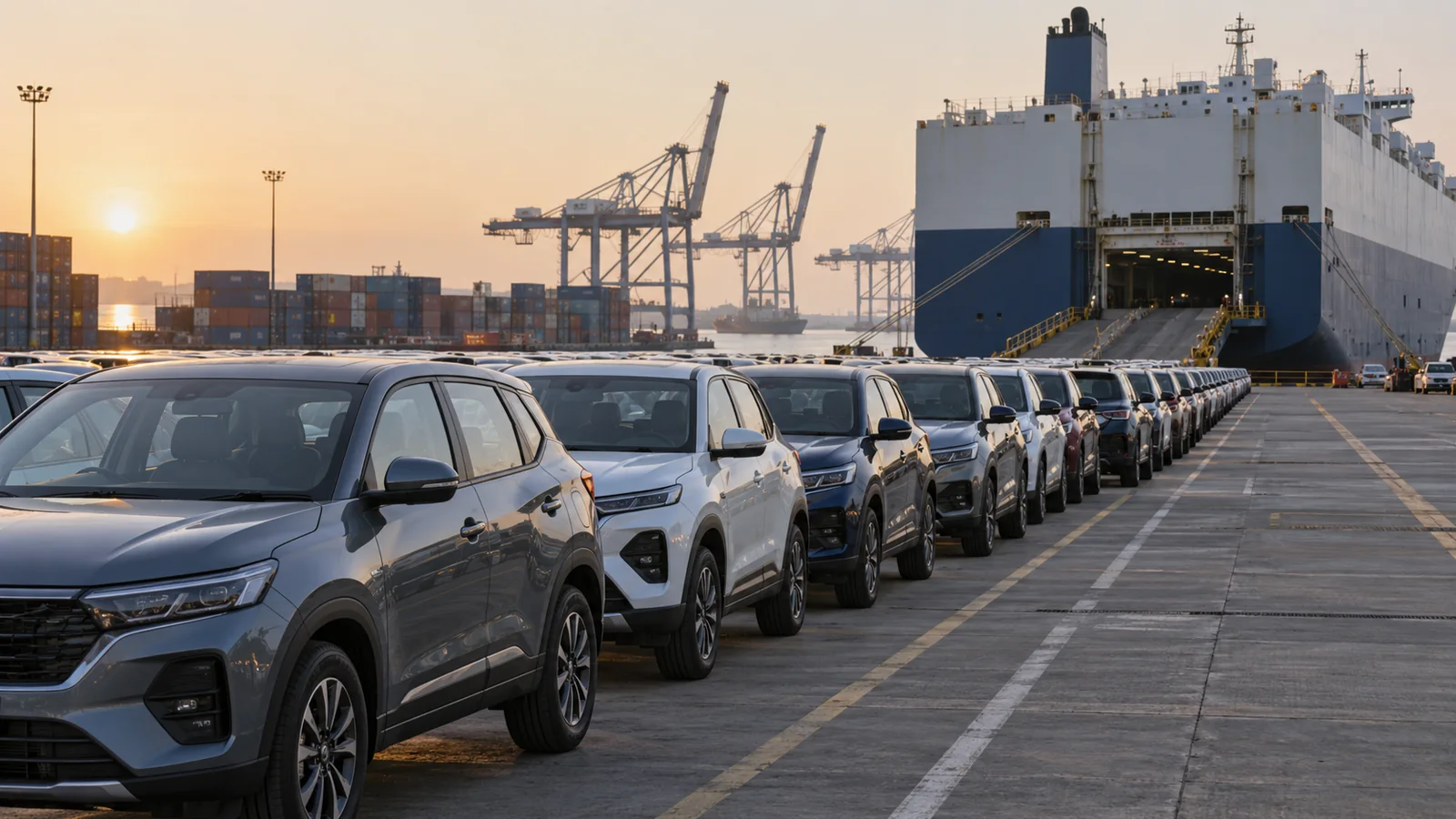
Primary sources: SIAM Annual Report 2025–26 summary, released 3 September 2026; SIAM Industry Trends; and SIAM Economic Contribution for FY2025–26, all accessed 6 October 2026. The cover image is an illustrative photograph of generic unbranded vehicles and does not depict a specific manufacturer or model.