Porsche Cayenne Electric India Launch: Price, Specs and Buyer Guide
Porsche India has launched the Cayenne Electric in two variants, adding a battery-electric option to one of its best-known SUV lines. The standard Cayenne Electric starts at ₹1,77,27,000, while the Cayenne Turbo Electric starts at ₹2,27,51,000. Porsche's official launch note says customer deliveries began on 30 September 2026, the same day as the Mumbai launch.
The electric variants expand the Cayenne range rather than replace it. Porsche India says petrol versions will continue to be sold into the next decade, giving buyers a direct choice between combustion and electric power within the same model family. The launch timing, two-variant lineup, published starting prices and delivery status come from the official Porsche India newsroom release.
Porsche Cayenne Electric India price and key specifications
| Specification | Cayenne Electric | Cayenne Turbo Electric |
|---|---|---|
| Published starting price | ₹1,77,27,000 | ₹2,27,51,000 |
| Overboost output with Launch Control | 325 kW / 442 PS | 850 kW / 1,156 PS |
| 0–100 km/h with Launch Control | 4.8 seconds | 2.5 seconds |
| Top speed | 230 km/h | 260 km/h |
| Drive and transmission | Electric all-wheel drive, automatic | Electric all-wheel drive, automatic |
Porsche publishes the variant performance data on its official India Cayenne Electric product page. The price is a starting point; a buyer's final on-road amount will depend on the configured vehicle, options, registration, insurance and other applicable charges. Obtain an itemised written quotation for the exact Porsche code before paying a booking amount.
Cayenne Electric charging: the 16-minute claim needs context
Porsche states that the Cayenne can charge from 10% to 80% in 16 minutes under optimal conditions. That result requires a CCS fast charger capable of more than 390 kW, more than 850 V and more than 520 A, with the battery at 15°C and the initial state of charge at 9%. The same India product page describes an 800-volt charging architecture with up to 390 kW, and up to 400 kW under specific conditions.
This is a technical maximum rather than a promise for every public-charging stop. Real charging speed varies with charger capability, battery temperature, state of charge, vehicle configuration, charging-curve behaviour and site conditions. Buyers should map the chargers on their actual intercity routes and verify whether those sites can deliver the required power reliably.
For home charging, Porsche's India page says the vehicle can use a wallbox with up to 11 kW, with up to 22 kW listed as optional. Before finalising the car, ask for a site survey that records the sanctioned electrical load, earthing, cable route, parking access, equipment cost, installation responsibility and expected charging time at the power available to your property.
Official India range figure: ask for the final local document
At the time of access on 4 October 2026, the main Porsche India product page displayed the combined ECE range as “TBA”. Buyers should therefore avoid relying on an international range figure or an unofficial advertisement as the final India-market number. Ask the Porsche Centre for the current local technical sheet, homologation information and the range figure attached to the exact configuration.
Even after a certified figure is published, real-world distance per charge will vary with speed, temperature, elevation, traffic, wheel-and-tyre choice, cabin cooling, driving style and payload. A practical test drive should include the buyer's typical urban route and, where possible, a representative highway section.
Cayenne Electric battery warranty explained
Porsche's India product page states that the high-voltage battery warranty covers material and manufacturing defects for eight years or 160,000 km, whichever comes first. It also states that at least 80% of original net battery capacity is guaranteed for up to three years or 60,000 km, followed by at least 70% remaining capacity until the end of the high-voltage battery warranty.
Read the complete warranty document before purchase. Ask what diagnostic threshold, testing method, exclusions and repair process apply; whether a capacity claim requires repeated workshop measurements; and whether the warranty transfers to a subsequent owner. Also confirm the separate warranties for the vehicle, charging equipment and installation work.
Space, towing and everyday usability
Porsche lists 781 litres of luggage capacity, expandable to 1,588 litres with the rear seats folded. The vehicle can tow up to 3,000 kg, rising to 3,500 kg with the optional Off-Road package, subject to the stated equipment conditions. Those figures make the electric model relevant beyond straight-line performance, but buyers should check how their chosen options affect payload, spare-wheel provision and usable cargo space.
For urban use, the vehicle's size and wheel choice deserve attention. Test parking ramps, basement clearances and the turning space at home. Large performance tyres can also have meaningful replacement cost and availability implications, so record the exact tyre specification and ask for a current replacement quotation.
Cayenne Electric vs Turbo Electric: which buyer fits each?
The standard Cayenne Electric already offers 442 PS of overboost output and a manufacturer-stated 4.8-second 0–100 km/h time with Launch Control. It is the more logical starting point for buyers who want the electric Cayenne's packaging, all-wheel drive and fast-charging system without prioritising the highest performance figure.
The Turbo Electric raises overboost output to 1,156 PS and cuts the stated 0–100 km/h time to 2.5 seconds with Launch Control. That capability should be evaluated alongside the higher purchase price, tyre and insurance costs, intended driving environment and the buyer's real use of the performance. Confirm which chassis, brake, wheel and comfort equipment is standard or optional on the exact Indian configuration.
Petrol Cayenne buyers still have a choice
Porsche India's launch release says petrol Cayenne variants will continue into the next decade. The new electric versions therefore create a parallel powertrain choice rather than an immediate all-electric replacement. Buyers should compare the complete ownership pattern: daily distance, ability to install home charging, highway routes, fuel or electricity cost, service requirements, expected holding period and resale assumptions.
A buyer with dependable home charging and predictable daily use may value the convenience of starting with a charged battery. A buyer who regularly travels through areas with limited fast-charging options may prefer the operational simplicity of petrol. Neither decision should be based on a single headline figure.
What to confirm in the Porsche quotation
- The exact model year, variant, Porsche code and manufacturing month.
- The starting price, optional equipment, registration, insurance and all other charges as separate lines.
- The confirmed delivery date and the price applicable if delivery is delayed.
- The local certified range and energy-consumption figures for the configured vehicle.
- The home-charger specification, installation cost, electrical work and warranty.
- The high-voltage battery warranty and capacity-retention terms in writing.
- The wheel and tyre size, replacement availability and spare-wheel or mobility-kit provision.
- The service package, roadside assistance and nearest high-voltage repair facility.
- The booking cancellation and refund conditions.
Porsche Cayenne Electric India launch: buyer takeaway
The Cayenne Electric gives Porsche India a high-performance electric SUV in two sharply differentiated variants. The official information confirms starting prices of ₹1.77 crore and ₹2.28 crore when rounded to two decimal places, deliveries from 30 September, very high overboost outputs and an advanced fast-charging system. It also confirms that petrol Cayennes will continue, so customers can choose the powertrain that suits their use rather than treating the EV as the only route forward.
The final decision should be based on the configured on-road cost, charging at home and on regular routes, warranty documents, local range certification and after-sales support. Before committing to a Porsche or another premium EV, check an indicative eligible loan amount and estimated EMI with AutoCred. Results are indicative; final eligibility, interest rate, tenure, documentation and approval depend on the lender's verification and policy.
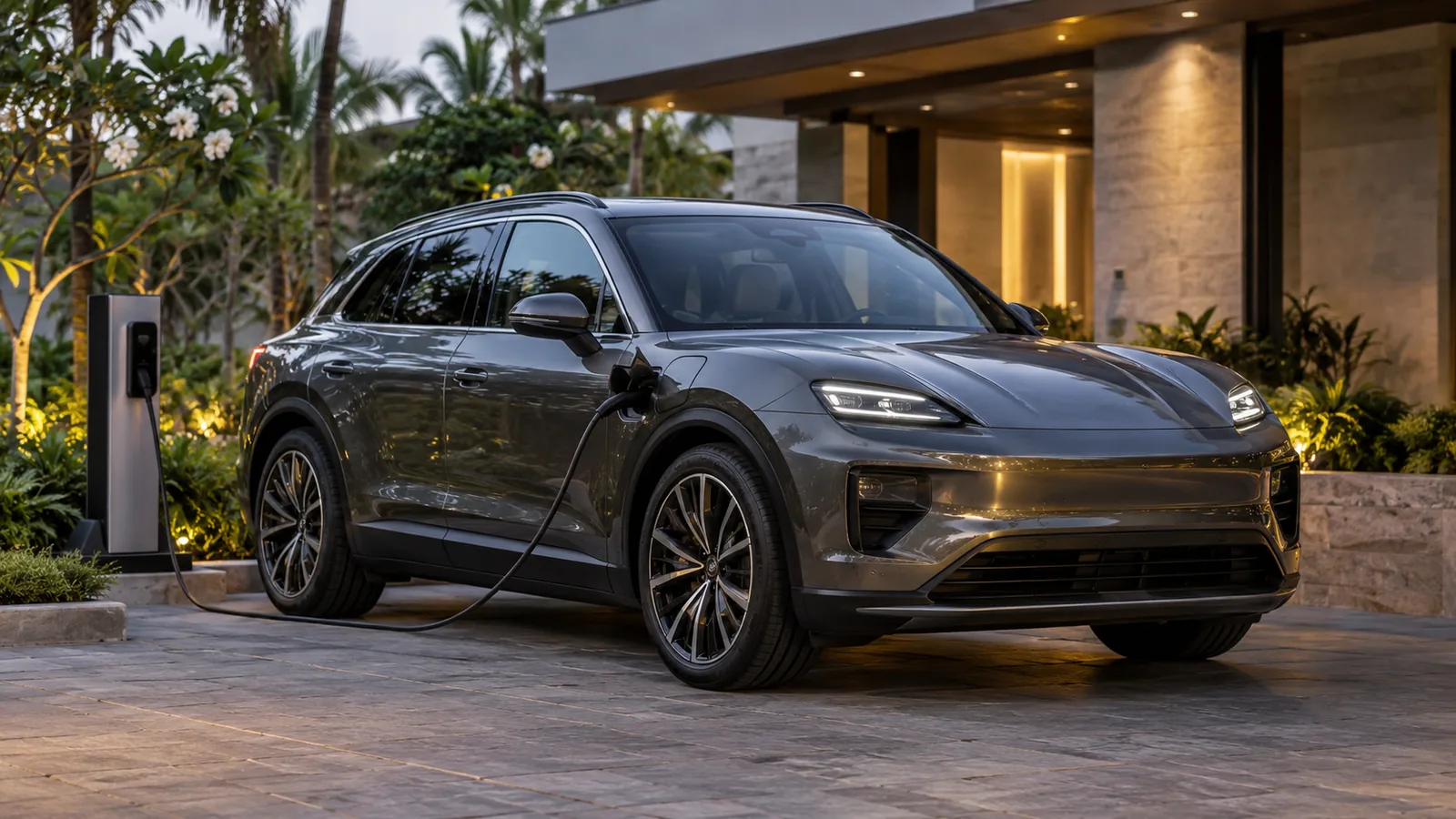
Primary sources: Porsche India Cayenne Electric launch release, published 30 September 2026, and the official Porsche India Cayenne Electric product page, both accessed 4 October 2026. Specifications, prices and availability can change; confirm the current local brochure and written dealer quotation. The cover is an illustrative image of a generic unbranded luxury electric SUV and does not depict an official Porsche model.