MG Hector Tomahawk EV vs PHEV: Price, Range and Buyer Guide
JSW MG Motor India has introduced the Hector Tomahawk with two electrified powertrains: a fully electric version and a plug-in hybrid. The decision creates a useful but complex choice for Indian SUV buyers. One version removes the petrol engine entirely, while the other combines a large electric-only range with a petrol engine for longer journeys.
The model was formally launched on 26 August 2026, and the company says bookings are open. According to the official JSW MG Motor India launch announcement, EV deliveries were scheduled to begin in September 2026, while PHEV test drives and deliveries are due to start in November 2026. Here is what the published prices, batteries, range claims and ownership plans mean before you shortlist a variant.
MG Hector Tomahawk EV and PHEV prices explained
MG has announced both Battery-as-a-Service (BaaS) and full-ownership prices. The introductory BaaS price starts at ₹13.99 lakh for the EV, plus a battery rental of ₹4.90 per kilometre. The PHEV starts at ₹21.79 lakh under BaaS, plus ₹3.20 per kilometre. These introductory BaaS offers are stated to apply to a limited number of bookings.
For customers who want the vehicle and battery together, the introductory ex-showroom price starts at ₹19.49 lakh for the EV and ₹25.69 lakh for the PHEV. The manufacturer's variant-wise price list publishes the following starting points:
| Powertrain | Introductory BaaS price | Battery rental | Introductory full-ownership price |
|---|---|---|---|
| Hector Tomahawk EV | From ₹13.99 lakh | ₹4.90/km | From ₹19.49 lakh |
| Hector Tomahawk PHEV | From ₹21.79 lakh | ₹3.20/km | From ₹25.69 lakh |
All four amounts above are manufacturer-published introductory figures. The full-ownership prices are ex-showroom, so registration, insurance, accessories and other on-road charges vary by location and quotation. A lower BaaS entry price should not be compared with a full-ownership price in isolation because the battery-rental contract adds an ongoing kilometre-based cost.
How the EV and PHEV powertrains differ
The Hector Tomahawk EV uses a 69.2 kWh battery, a permanent-magnet synchronous motor producing 150 kW and 310 Nm, and supports DC charging at up to 90 kW. MG publishes an ARAI/MIDC-certified range of 517 km on one charge. Certification provides a common comparison point, but actual range changes with speed, traffic, temperature, climate-control use, gradients, tyre pressure and vehicle load.
The PHEV pairs a 1.5-litre petrol engine with a dedicated hybrid transmission, a 20.5 kWh battery and a 148 kW electric motor. MG claims more than 115 km of pure-electric driving and a combined range above 1,100 km with a full tank and full charge. The company also describes four operating modes: pure electric, series hybrid, parallel hybrid and engine-direct drive. Those published figures and modes appear in the official technical overview; real-world results will depend on conditions and how often the PHEV is charged.
EV deliveries have begun; PHEV buyers wait until November
Timing may decide which version some buyers can consider immediately. MG's August launch release scheduled EV deliveries from September 2026 and PHEV test drives and deliveries from November 2026. The company's August 2026 sales update subsequently said dispatches of the EV were underway and repeated the November timing for the PHEV.
Ask the dealership for a written delivery estimate for the exact colour, seating layout and variant. A national launch schedule does not guarantee stock at every dealership, and delivery dates can change with allocation and logistics.
Seating and size: one key difference between the two versions
The EV is offered in five-seat and seven-seat configurations, while the PHEV is available only as a seven-seater. MG lists the SUV at 4,745 mm long, 2,130 mm wide including mirrors and 1,770 mm tall, with a 2,810 mm wheelbase. The company also states ground clearance of 230 mm at the battery.
The five-seat version has a claimed boot capacity of up to 610 litres with all seats in use. Seven-seat buyers should inspect third-row access, knee room and luggage space with every row raised. A large exterior does not by itself answer whether the final row and boot will work for a family's regular travel pattern.
Technology and safety equipment to verify by variant
MG's launch specification includes six airbags as standard across variants, electronic stability control, traction control, hill hold, ABS with EBD, tyre-pressure monitoring, ISOFIX mounts and all-wheel disc brakes. The company also lists a 360-degree camera and Level 2 advanced driver-assistance functions including adaptive cruise control, lane-keeping assistance, forward-collision warning and automatic emergency braking.
Cabin technology includes a 15.6-inch HD display, an 8.8-inch driver display, wireless Apple CarPlay and Android Auto, and i-SMART 3.0 with more than 80 connected features. MG additionally describes a generative-AI voice assistant that understands more than 30 Hinglish commands and a Vehicle-to-Home function that can supply power from the vehicle battery.
Feature availability can differ by variant and may depend on software, connectivity or compatible equipment. Verify the final feature list, subscription requirements and operating limits in the current brochure and written order form. Driver-assistance technology supports the driver; it does not replace attentive driving.
BaaS or full battery ownership: what to compare
BaaS reduces the published upfront vehicle price by separating the battery from the purchase. It may suit a buyer who values a lower initial outlay and understands the rental contract. Full ownership is simpler for buyers who prefer one purchase price and do not want a kilometre-linked battery payment.
Before choosing BaaS, ask for the complete agreement and examine minimum monthly usage, billing method, taxes, escalation clauses, excess-kilometre treatment, early termination, vehicle resale, insurance responsibilities and what happens if the vehicle is unused. Also confirm whether the rental is included in any loan calculation or must be paid separately.
MG states that a lifetime battery warranty is offered to the first owner of both EV and PHEV. The phrase “first owner” is important. Ask for the warranty document, coverage limits, exclusions, transfer rules, required service schedule and the relationship between the warranty and BaaS contract before relying on it.
Who should consider the Hector Tomahawk EV?
The EV is the more direct choice for a household with dependable home or workplace charging and predictable daily travel. It avoids petrol use and offers the lower published starting price under both BaaS and full ownership. Its 517 km certified range is strong on paper, but the practical decision should be based on regular routes, overnight charging, highway charging reliability and the range buffer you want to maintain.
Buyers who take frequent intercity trips should map chargers they can actually use, check connector compatibility and examine how the 90 kW maximum DC rate translates into charging time at different battery levels. A test drive should also include ride comfort, braking feel, visibility, rear-seat comfort and parking in the places you use most often.
Who should consider the Hector Tomahawk PHEV?
The PHEV may better suit drivers who can charge regularly for local journeys but want a petrol-powered fallback for long or uncertain routes. Its claimed 115-plus-kilometre electric range could cover many daily patterns without starting the engine, while the combined range claim is aimed at long-distance flexibility.
That benefit depends on charging behaviour. A plug-in hybrid driven mostly without charging carries a battery and electric system without using their full benefit. Compare fuel consumption with a depleted battery, charging time, boot and cabin packaging, service requirements for both propulsion systems and the higher purchase price. Since customer test drives begin in November 2026, the final decision should follow a drive of the production PHEV rather than the specification sheet alone.
A practical checklist before booking
- Obtain a written on-road quotation for the exact variant, colour and seating layout.
- Compare the complete BaaS contract with the full-ownership price over your expected annual kilometres.
- Confirm the charger, installation scope, electrical upgrades and expected installation time.
- Read the vehicle, battery and roadside-assistance warranty documents.
- Verify ADAS, camera, connected-car and comfort features on the exact variant.
- Check insurance treatment for the battery under BaaS and full ownership.
- Ask for a written delivery estimate and refund conditions before paying a booking amount.
- Test the second and third rows with the passengers who will use them regularly.
MG Hector Tomahawk EV vs PHEV: the buyer takeaway
The EV offers the lower entry point and a straightforward zero-tailpipe-emission powertrain for buyers with reliable charging. The PHEV costs more but adds petrol-backed long-distance flexibility and a substantial claimed electric-only range. BaaS can reduce the initial price for either version, although its continuing rental means the contract deserves the same attention as the vehicle quotation.
Before deciding, use AutoCred's eligibility checker to review an indicative eligible loan amount and estimated EMI. It can help you identify a realistic variant and down payment before visiting the showroom. Results are indicative; final eligibility, interest rate, tenure, documentation and approval remain subject to the lender's verification and policy.
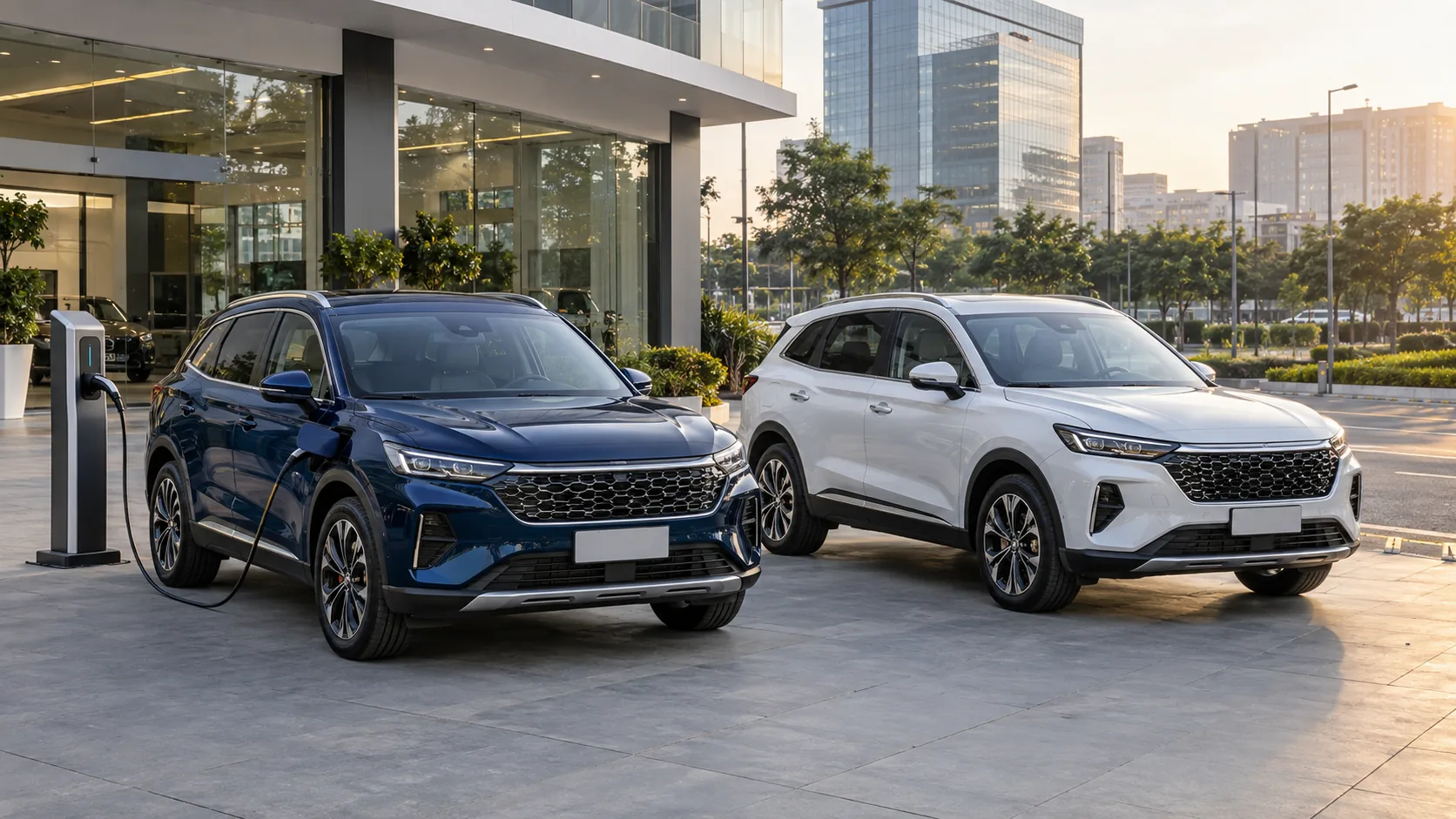
Primary sources: JSW MG Motor India — Hector Tomahawk EV and PHEV launch release, 26 August 2026; JSW MG Motor India — August 2026 sales update. Accessed 1 October 2026. The cover image is an illustrative depiction of generic unbranded electrified SUVs and does not show an official MG vehicle design.