India’s Battery Black Mass Export Ban: What It Means for EV Supply
India has moved a specific lithium-ion battery recycling material from “Free” to “Prohibited” for export. The Directorate General of Foreign Trade (DGFT) made the change through Notification No. 49/2026-27, dated 10 November, with immediate effect and until further orders. The government’s stated aim is to keep more recoverable material available to domestic recyclers and refiners, strengthening a supply chain that also serves electric vehicles. The Press Information Bureau’s official explanation of the notification sets out its scope and rationale.
What does the export ban cover?
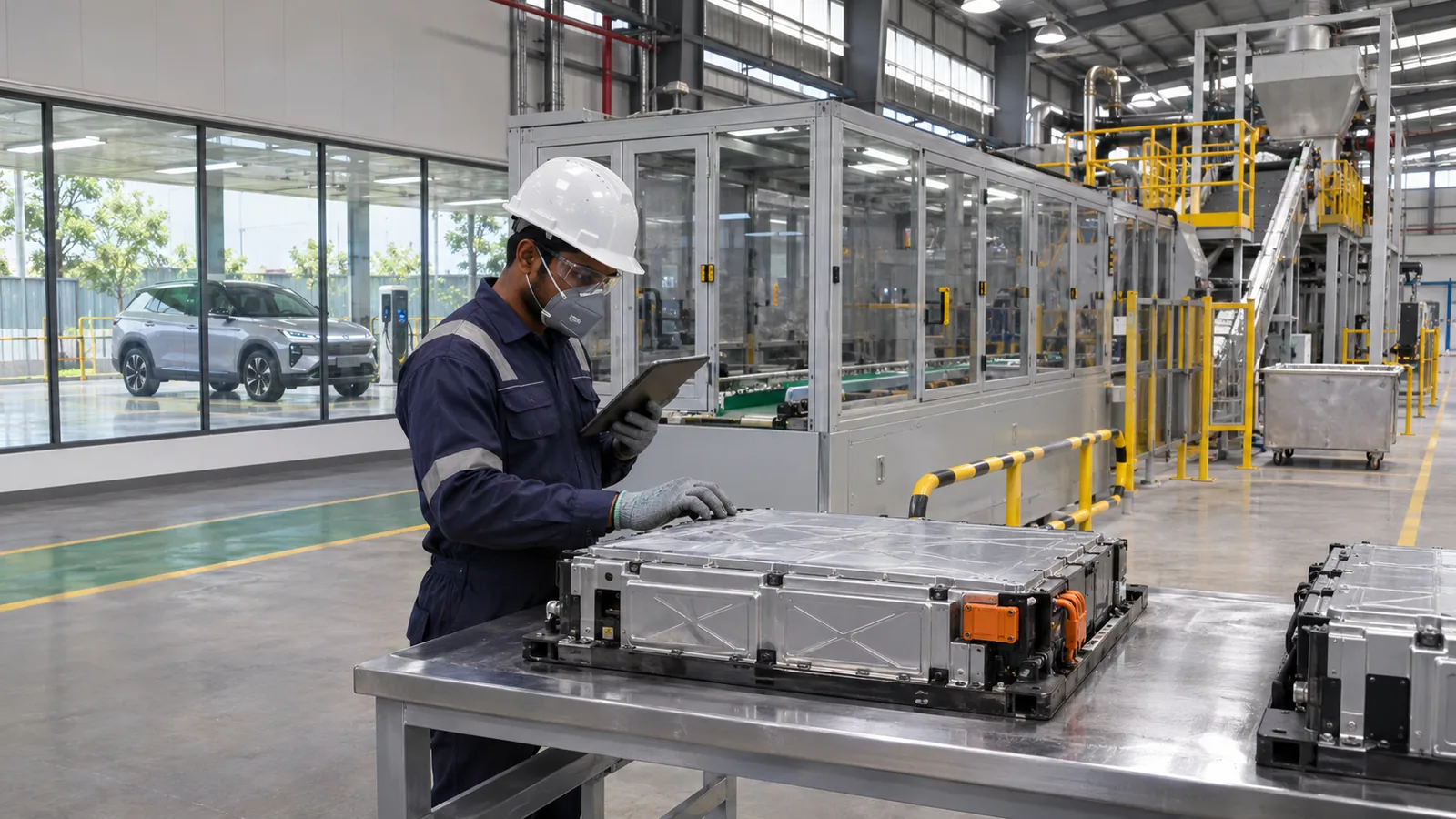
The rule applies to lithium-ion battery black mass under ITC (HS) code 85491400. The government describes that classification as unsorted waste and scrap of cells, batteries and accumulators that does not contain lead, cadmium or mercury. Black mass is the powder produced when end-of-life lithium-ion batteries or battery-manufacturing waste is shredded; it contains recoverable minerals including lithium, cobalt, nickel and manganese. This is a specific material classification, not a blanket export ban on finished batteries or every battery-related product. DGFT Notification No. 49/2026-27.
Why the move matters to the EV supply chain
Black mass is an intermediate material: it needs further processing before its recovered minerals can become inputs for new products. The Commerce Ministry says domestic recycling and refining capacity is not being fully used because feedstock is inadequate; it also says some recyclers have imported material while Indian-generated black mass was exported. Keeping the material in India is intended to improve feedstock availability, support capacity use and encourage investment. These are the government’s expected outcomes, not a guarantee that recycling output or battery-material costs will change immediately. The PIB release also links the measure to the National Critical Mineral Mission.
The policy complements the government’s ₹1,500 crore incentive scheme for critical-mineral recycling, approved in September 2025, which is intended to develop recovery capacity from secondary sources such as battery waste and e-waste. Together, the measure and the scheme point to a policy effort to build more domestic processing capability. The notification also says transitional arrangements under Paragraph 1.05 of the Foreign Trade Policy 2023 apply; businesses handling affected shipments should check the official text and seek trade-compliance advice for their specific circumstances. See the official PIB release for the scheme and transitional provision.
What it does—and does not—mean for car buyers
For a prospective EV buyer, this is a supply-chain and industrial-policy development, not a new vehicle announcement. It does not by itself confirm lower battery prices, a change in EV range, or a near-term change in showroom prices. Any effect would depend on how much material is collected, the ability of Indian facilities to process it, and the quality and cost of recovered materials. The policy’s direction is relevant to long-term battery manufacturing and EV supply resilience, but near-term vehicle decisions should still rely on the model’s confirmed price, warranty, charging support and ownership costs.
If you are also budgeting for a personal car, AutoCred’s loan eligibility check can show an indicative eligible amount and estimated EMI before you shortlist models or visit a dealer. Results are indicative; final eligibility, rate, tenure and approval depend on the lender.
What to watch next
The policy’s practical effect will become clearer through implementation: how the transitional provision is applied, whether domestic recyclers receive a more reliable supply of suitable material, and whether new investment follows. For the automotive sector, the key measure will be whether recovered minerals can be processed consistently and competitively enough to become a dependable input—not simply whether black mass stays within the country.
Before making a car shortlist, check an indicative eligible amount and estimated EMI with AutoCred. These results are indicative, and final eligibility, rate, tenure and approval depend on the lender.